Tuesday, September 7, 2010
2010 Hyundai Tucson 

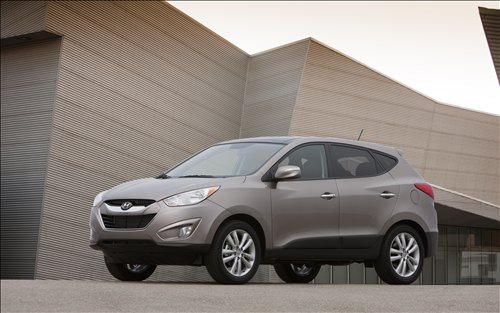
2010 Hyundai Tucson

2011 hyundai tucson
The Hyundai Tucson is almost identical to its European and Korean-market counterparts, and is built on the same Elantra-based platform as the Kia Sportage. For the latest model, the Tucson benefits from Hyundai’s newest “fluidic sculpture” design themes, and improves significantly in style compared to the outgoing model.
Like the Sonata, the Tucson is powered exclusively by a 2.4-liter four-cylinder Theta engine that cranks out 176 horsepower — more than the outgoing model’s optional V6. Hyundai expects fuel economy to top out at an impressive 31 mpg on the highway (23 around town) with the optional six-speed automatic (six-speed manual standard) and the base front-wheel-drive setup. Expect a hit for all-wheel-drive models — Hyundai estimates 21 mpg around town and 28 mpg on the highway.
The outgoing model features three trim levels and two engines, and the latest model features two trim levels and a single engine for launch. The now standard model is labeled as the GLS, and the range-topping model remains the Limited.
The latest Tucson is now complemented with more agile handling, responsive steering and improved body roll control. Enhancements such as the MacPherson strut front and multi-link rear suspension systems provide more precise wheel control and a smoother ride and make the new Tucson more fun-to-drive. To further aid in improved handling manners, stabilizer bar diameters have also increased with the front suspension growing to a 25 mm hollow stabilizer bar, yet saving weight versus the predecessors 21 mm solid stabilizer bar. The rear suspension has a new 18 mm solid stabilizer bar versus the predecessors 14 mm stabilizer bar. These larger stabilizer bars help to keep the vehicle flat during cornering and help provide quicker turn-in response.
The newest Tucson is actually longer than its predecessor by about 3.3 inches, but weighs in at 3,203 lbs — 61 lbs less than the outgoing model. This extra length helps inside, as the Tucson grows significantly in terms of both design and space. An optional panorama moonroof, Bluetooth and a CleanAir ionizer for the climate control system up the luxury ante.
Although not immediately available at launch, Hyundai will offer a Tucson Blue with an efficiency-oriented 2.0-liter base engine with dual variable valve timing that will achieve better fuel economy and power than the outgoing four-cylinder base engine. Both engines will be available with either six-speed automatic or manual gearboxes.
 2011 Hyundai Tucson
 2011 Hyundai Tucson Back view
 2011 Hyundai Tucson Side View
2011 Hyundai Tucson Back Side View
2011 hyundai tucson
The Hyundai Tucson is almost identical to its European and Korean-market counterparts, and is built on the same Elantra-based platform as the Kia Sportage. For the latest model, the Tucson benefits from Hyundai’s newest “fluidic sculpture” design themes, and improves significantly in style compared to the outgoing model.
Like the Sonata, the Tucson is powered exclusively by a 2.4-liter four-cylinder Theta engine that cranks out 176 horsepower — more than the outgoing model’s optional V6. Hyundai expects fuel economy to top out at an impressive 31 mpg on the highway (23 around town) with the optional six-speed automatic (six-speed manual standard) and the base front-wheel-drive setup. Expect a hit for all-wheel-drive models — Hyundai estimates 21 mpg around town and 28 mpg on the highway.
The outgoing model features three trim levels and two engines, and the latest model features two trim levels and a single engine for launch. The now standard model is labeled as the GLS, and the range-topping model remains the Limited.
The latest Tucson is now complemented with more agile handling, responsive steering and improved body roll control. Enhancements such as the MacPherson strut front and multi-link rear suspension systems provide more precise wheel control and a smoother ride and make the new Tucson more fun-to-drive. To further aid in improved handling manners, stabilizer bar diameters have also increased with the front suspension growing to a 25 mm hollow stabilizer bar, yet saving weight versus the predecessors 21 mm solid stabilizer bar. The rear suspension has a new 18 mm solid stabilizer bar versus the predecessors 14 mm stabilizer bar. These larger stabilizer bars help to keep the vehicle flat during cornering and help provide quicker turn-in response.
The newest Tucson is actually longer than its predecessor by about 3.3 inches, but weighs in at 3,203 lbs — 61 lbs less than the outgoing model. This extra length helps inside, as the Tucson grows significantly in terms of both design and space. An optional panorama moonroof, Bluetooth and a CleanAir ionizer for the climate control system up the luxury ante.
Although not immediately available at launch, Hyundai will offer a Tucson Blue with an efficiency-oriented 2.0-liter base engine with dual variable valve timing that will achieve better fuel economy and power than the outgoing four-cylinder base engine. Both engines will be available with either six-speed automatic or manual gearboxes.
2011 Hyundai Tucson2011 Hyundai Tucson Back view2011 Hyundai Tucson Side View2011 Hyundai Tucson Back Side View
Friday, March 12, 2010


